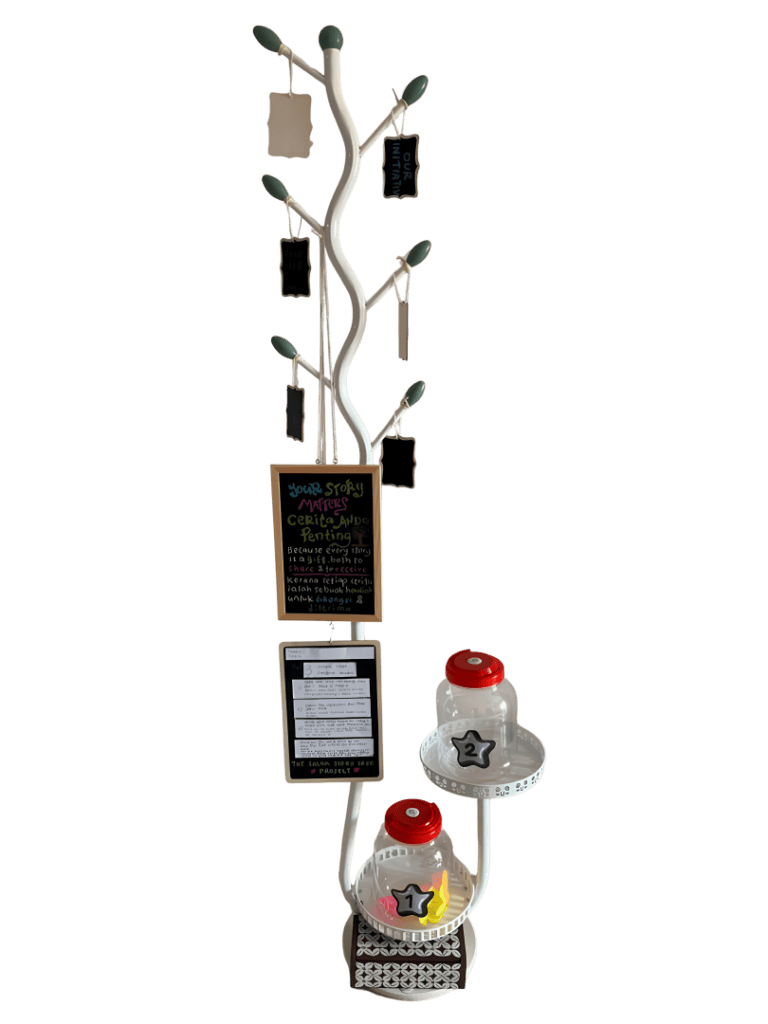
Salam Story Tree Concept Summary

Baca Cerita. Tinggalkan Daun. Tumbuh Bersama.
1. What is the Salam Story Tree?
The Salam Story Tree is a participatory storytelling, reflection and community-listening activity developed by Salam Organisation for Social Sustainability.
It creates a simple and welcoming space where people can encounter another person’s story, pause to reflect, and voluntarily leave a small part of their own story for someone else to discover.
The activity uses a physical tree as a metaphor for human life and relationships. Participants interact with stories through leaves, reflection cards, jars, a Reflection Box and mirrors. The experience is intentionally designed to move participants from reading and receiving a story, to reflecting, listening, recognising different perspectives and contributing a story of their own.
The Story Tree can be used in dialogue-storytelling spaces, community programmes, youth activities, intercultural and interfaith encounters, public engagement events and other settings where people are encouraged to understand one another beyond labels and assumptions.
It is not a therapy activity, diagnostic tool or research instrument. It is a psychologically informed and faith-sensitive community reflection methodology that encourages voluntary participation, dignity and curiosity.
2. Why a Story Tree?
SALAM believes that people often encounter one another first through categories:
- religion
- ethnicity
- nationality
- profession
- age
- gender
- social status
- political or cultural identity
These identities can be important, but they can also influence what we assume about another person before we have actually heard their story.
The Story Tree therefore creates a small pause between identity and interpretation.
Instead of beginning with:
“Who are you?”
the activity begins with:
“What story can you receive from another person?”
And then:
“What does that story make you think, feel or reflect upon?”
The purpose is not to remove identity from dialogue. Rather, it allows participants to encounter human experience first, and then allow identity and background to deepen the understanding of that experience.
This reflects SALAM’s principle:
Let the story introduce the person. Let identity deepen the story — not define it.
3. The Philosophy Behind the Tree
The Tree represents the idea that every person carries a larger story than what is immediately visible.
Roots — What formed us
Our values, family, faith, culture, experiences, memories and formative relationships.
Trunk — What holds us together
Our character, identity, beliefs, sense of self and meaning.
Branches — Where our lives connect
Family, friendship, work, community, faith and relationships.
Leaves — What we choose to share
A moment, thought, feeling, lesson, question, hope or reflection.
A single leaf does not represent an entire person.
This is an important principle of the Story Tree:
A story is a window into a person, not a definition of the person.
Fruit — What stories can produce
Understanding, empathy, dialogue, learning, responsible choices and meaningful relationships.
Seeds — What we leave for others
A story or insight that may continue to influence another person long after the original encounter.
4. Islamic and Ethical Inspiration
The Story Tree is a contemporary community activity inspired by values found in Islamic tradition. It is not a religious ritual or a practice prescribed by Islam.
One of its key inspirations is the Qur’anic imagery in Surah Ibrahim 14:24–25, where a good word is compared to a good tree with firm roots and branches reaching upwards, producing fruit.
For SALAM, this provides a meaningful metaphor:
Words can take root, travel beyond the person who speaks them, and produce consequences in the lives of others.
The activity also draws upon broader Islamic ethical principles including:
Ta’aruf — knowing and encountering one another beyond assumptions.
Istima’ / attentive listening — receiving what another person says before rushing to judgement.
Tawadu’ — recognising that our own perspective may be incomplete.
Shura — creating space for people to contribute their perspectives.
Rahmah — approaching another person’s story with compassion and dignity.
Amanah — treating another person’s story as something entrusted to us rather than something to exploit.
Ta’awun — using understanding to contribute positively to others.
These principles are translated into a contemporary, inclusive dialogue activity that can be experienced by people from different faiths and backgrounds.
5. Psychological and Social Learning Dimension
The Story Tree is psychologically informed, but it is not presented as a clinically validated psychological intervention.
Its design draws upon several ideas relevant to human learning and dialogue:
Narrative reflection
People often make sense of their experiences through stories. Writing or reading a short story can help a participant step back and consider an experience from another perspective.
Perspective-taking
Participants encounter an experience that may be different from their own, encouraging curiosity about how another person sees the world.
Metacognition
The activity asks participants not only what they think about a story, but also:
“Why did I react to this story in this way?”
This can reveal assumptions, emotions and previous experiences influencing their interpretation.
Social learning
Participants may encounter a perspective or behaviour from another person’s experience that gives them a new possibility to consider.
Psychological safety
Participation is voluntary. Participants can choose how much they share, whether to remain anonymous and whether to pass.
The activity therefore creates an opportunity for meaningful participation without requiring personal disclosure or public speaking.
6. The Components
The physical Story Tree consists of several simple elements.
A. The Tree
The central visual structure where participants see the whole structure holding multiple items. Each hanging leaf board shows background / initiatives of Salam Social Society with QR Code printed on the back where public can explore more.
B. The Story Jars
Jar 1 containing previously written anonymous leaves where participants can keep themselves.
Participants take one leaf from the jar and read a story left by someone else. Stick notes or we called it ‘Story Leaf’ shows the growing collection of individual experiences within a community.
This creates the first encounter:
Receive before responding.
The participant does not know the writer’s status, profession, religion or background unless the writer voluntarily included it.
This helps reduce the tendency to interpret a story immediately through social labels.
C. The Reflection Box
The Reflection Box provides a private space for participants to pause and process their response.
A simple prompt may ask:
“What did this story make you feel, think or remember?”
Participants can write privately before deciding what they wish to contribute.
The Reflection Box also protects the principle that not every reflection needs to become public.
D. The Mirror inside Reflection Box
The mirror introduces the idea of self-awareness and perspective.
A normal mirror represents:
What can I see about myself?
A convex mirror can represent:
What might I be missing because of my limited perspective?
The mirror therefore becomes a physical metaphor for blind spots.
It connects the Story Tree with SALAM’s wider work on bias, intercultural competence and reflective dialogue.
E. The Empty Leaves
Participants receive a blank leaf on which they may leave something for another person.
This can be:
- one word
- one sentence
- a question
- a reflection
- a lesson
- a hope
- a personal insight
- a drawing or symbol
Participants are not required to tell their whole story.
A leaf does not need to carry the whole tree.
F. Then 2nd Jar
After reflecting and writing, the participant places the leaf in the second jar where it will be used for reflection analysis during Salam Group meeting before it enters the 1st Jar with the whole process starts for each theme.
As more people participate, the Tree becomes a visual representation of a community’s collective stories.
The physical act represents:
“I have something to contribute to the understanding of others.”
7. How to Play / Participant Journey
The activity can be completed in approximately 5–10 minutes, depending on the depth of reflection.
STEP 1 — Choose
The participant approaches the Story Tree voluntarily.
They are introduced to the activity and its privacy principles.
Participation is optional.
STEP 2 — Receive a Story
The participant takes one anonymous leaf from the 1st Story Jar.
They read it quietly.
They are encouraged not to immediately judge, analyse or identify the writer.
Instead:
Pause. Read. Receive.
STEP 3 — Look at the Mirror
The participant is invited to consider:
“What did I notice in myself while reading this?”
and:
“Could there be something I am not seeing?”
This creates a bridge from another person’s story to self-reflection.
STEP 4 — Reflect
The participant may use the Reflection Box or reflection card.
Suggested prompt:
“What did this story make me feel, think or remember?”
There is no requirement to share the answer.
STEP 5 — Write Your Leaf
The participant receives a blank leaf.
Prompt:
“What is one thing you would like another person to stop for a moment to feel, think about or understand?”
The participant may write as much or as little as they wish.
No name is required.
STEP 6 — Leave the Leaf in the 2nd Jar
The participant put the leaf in the 2nd jar.
The participant’s story now becomes part of the community’s growing collection of experiences.
STEP 7 — Continue the Conversation
Where appropriate, participants may discuss:
What did you notice?
What surprised you?
Did the story challenge an assumption?
What perspective did you encounter?
What might you carry forward?
The conversation should remain voluntary and respectful.
8. Theme-Based Story Trees
The Story Tree can be adapted according to the event or dialogue theme.
For example:
Identity
“What is something about your identity that people often misunderstand?”
Belonging
“When have you felt that you truly belonged somewhere?”
Interfaith Dialogue
“What is one value from your faith or worldview that you hope others understand?”
Intercultural Dialogue
“What is something from your culture that you wish people would ask about rather than assume?”
Youth
“What is something you wish adults understood about young people today?”
Community
“What is one small thing someone did that made your community feel more human?”
KL Dialogue Cities
A possible theme:
“What is one story from your city that you wish people from another background could hear?”
The theme provides a common doorway while leaving participants free to decide what they personally wish to share.
9. Privacy and Dignity Principles
The Story Tree follows several important safeguards.
Participation is voluntary.
No participant is required to reveal their identity.
Participants should avoid identifying or exposing another person without consent.
Stories should not contain unnecessary sensitive or private information.
A story left on the Tree is not automatically permission to publish it publicly.
Consent to participate is different from consent to photograph, publish or reproduce a story.
Facilitators may remove a leaf if it contains identifying, harmful, defamatory or otherwise inappropriate content.
Sensitive disclosures should not automatically be read aloud or displayed publicly.
The principle is:
Receive stories with dignity; never treat people’s vulnerability as content.
10. What Makes the Story Tree a Dialogue Tool?
The Story Tree does not attempt to make everyone agree.
Its purpose is to create the conditions for people to:
encounter → listen → reflect → question assumptions → understand → connect.
Dialogue begins before people speak to one another.
Sometimes it begins when we are willing to sit quietly with another person’s story.
The Story Tree therefore works as a pre-dialogue and dialogue-support tool.
It can help participants arrive at a conversation with greater curiosity rather than immediately entering debate.
11. What SALAM Hopes the Tree Will Grow
The physical Tree is only the visible part.
The deeper intention is to cultivate:
Self-awareness
→ Curiosity
→ Perspective-taking
→ Empathy
→ Dialogue
→ Responsible choice
→ Connection
→ Contribution
In this sense:
The Tree is not the destination. It is a doorway into dialogue.
12. The Core Philosophy
The SALAM Story Tree can ultimately be summarised in five principles:
Every person carries a story.
No single story defines an entire person.
Listening can happen before agreement.
Difference becomes easier to encounter when we begin with humanity rather than assumptions.
Stories become socially meaningful when reflection leads to understanding, connection and responsible action.
SALAM’s central invitation:
Read a Story. Leave a Leaf. Grow Together.
A small leaf may represent only a few words.
But behind those words is a human being.
And when many leaves come together, the Tree reminds us that a community is not built only from institutions, policies or programmes — it is also built from the stories people are willing to share, receive and carry forward.